Salary Benchmarks by Job Title in 2026: What 2.5M+ Job Postings Actually Pay
Most salary benchmarks online come from one of two places: self-reported surveys (small samples, self-selection bias, whoever bothered to fill out the form) or government labor statistics (accurate, but often a year or more behind). Neither is wrong, but neither is current, and neither is drawn from what employers are actually posting right now.
This report uses a third source: real, live job postings from OmniJobs' database of 2.5 million+ active listings. Not what someone said they were paid — what companies are currently advertising for the role.
🔬 Methodology
- Source: OmniJobs' job postings database, trailing 6 months, active listings only, postings with a disclosed salary range (capped under $2M to exclude parsing errors).
- Disclosure rate: only 22.2% of postings in this window disclose salary at all (313K of 1.4M). This is the single most important caveat in this report — our numbers describe the companies that publish pay, which skews toward larger employers and pay-transparency jurisdictions (most U.S. states, UK, EU). It is not necessarily representative of the market that doesn't disclose.
- Median over average: several roles show a meaningful gap between the average and the median — a sign of a right-skewed distribution where a small number of high-paying postings pull the average up. We lead with median (of the posted min–max midpoint) as the more honest "typical" figure, and show the average min–max as the range you'd realistically see posted.
- Sample floor: roles below 200 postings in the window are excluded to avoid noisy small-sample numbers.
- Refresh cadence: monthly. See the update log at the bottom.
💵 Finding 1: Median Salary by Role
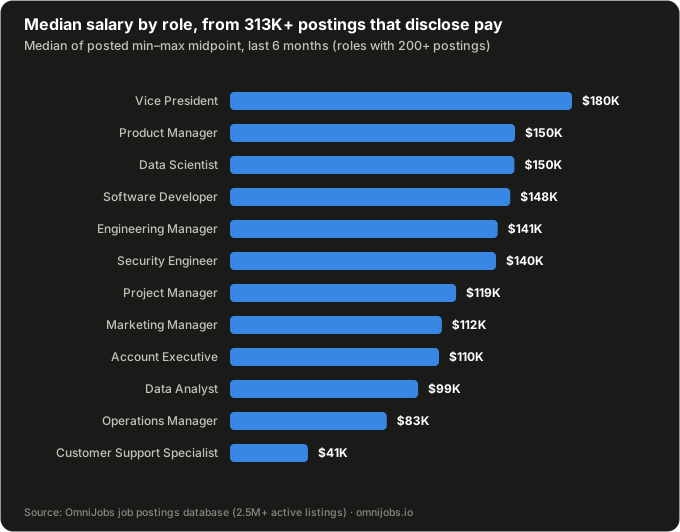
A few things stand out. Product Manager and Data Scientist post nearly identical medians ($150K), both slightly ahead of Software Developer ($147.5K) — a reminder that in 2026, individual-contributor technical roles aren't automatically the ceiling; specialized and cross-functional roles compete closely with them. Security Engineer ($140K) sits close to Engineering Manager ($140.9K), which is a genuinely useful data point if you're weighing a specialist track against a management track.
The average-vs-median gap is worth a specific callout: Operations Manager's average range midpoint was $94K in our raw pull, but the median is $82.5K — a $11.5K gap, the largest of any role we measured. That means a meaningful share of Operations Manager postings sit well above the typical listing, pulling the average up. If a number you see elsewhere looks higher than what you're actually being offered, this is often why — check whether it's an average or a median before assuming you're being lowballed.
📊 Finding 2: The Software Developer Salary Ladder
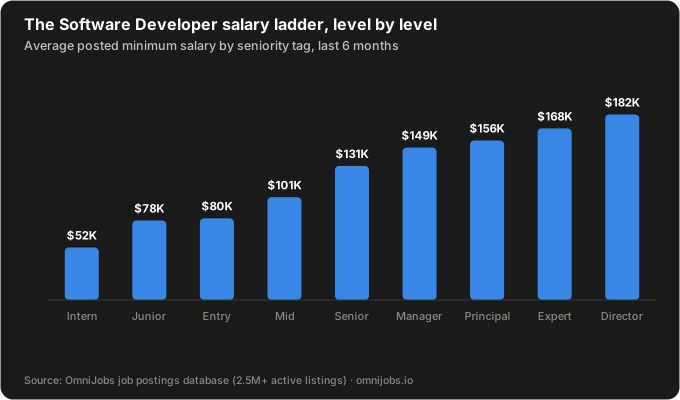
This is the most useful chart in this report if you're negotiating: seniority tags give a clean, nearly monotonic salary ladder from Intern ($52K) through Director ($182K). The two biggest single jumps are Mid → Senior (+$30K) and Manager → Principal is comparatively modest (+$7K) — meaning the Senior transition, not the jump into management, is where the steepest pay increase actually happens for this role. Entry ($80K) edging slightly above Junior ($78K) in our data is noise, not signal — the two tags are used near-interchangeably in postings and shouldn't be read as a meaningful reversal.
Product Manager shows the same overall shape on our data: Junior/Entry PM postings average around $72–73K, climbing through Mid-level ($101K) and Senior ($135K) to Manager ($128K) and Principal ($165K) — confirming this isn't a Software-Developer-specific pattern but a general feature of how seniority maps to pay.
🌍 Finding 3: Remote Roles Pay More — Across the Whole Market
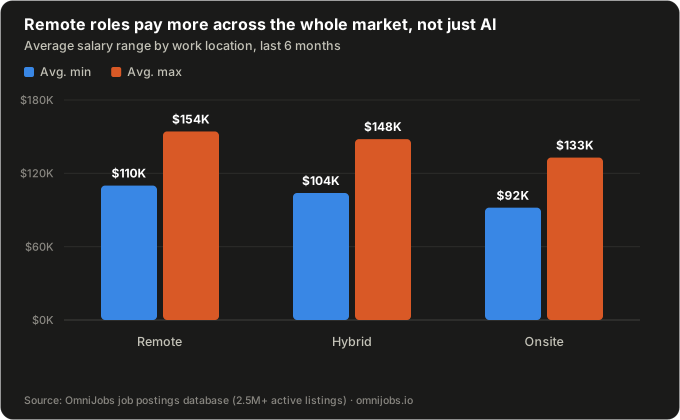
We found something similar to this in our State of AI Jobs 2026 report, but scoped only to AI-tagged roles. This finding is different and broader: across the entire market, remote roles average $110K–$154K against onsite's $92K–$133K — roughly a 20% premium on the floor, holding up at real sample sizes across all three work-location types. Hybrid sits in between, close to remote on both ends. If remote flexibility matters to you, the data says it isn't a trade-off against pay in the general market — the opposite is closer to true.
🧭 What This Means If You're Negotiating Right Now
- Ask whether a number is an average or a median — the gap can be $10K+ for some roles, and it changes what "market rate" actually means for your offer.
- The Senior transition is where the money is, at least for Software Developer — if you're a Mid-level engineer, that promotion case is worth more than the jump after it.
- Remote isn't a pay cut in this data — it's a premium. Don't assume you need to trade salary for flexibility without checking.
- Treat any single month as a data point, not gospel. Check back — this report updates monthly, and next month's numbers are the real test of whether these patterns hold.
🚀 Try OmniJobs
Every number above came from the same 2.5 million+ listing database that powers OmniJobs' daily AI-matched job scan — scored against your actual resume, with real-time alerts the moment a strong match goes live.
For the AI-specific salary and remote-work findings, see our State of AI Jobs 2026 report. If you're weighing a career shift and want matching that understands transferable skills, see our guide to automated job matching platforms for career shifts.
👉 Visit OmniJobs and get matched against roles with the pay data to back your next negotiation.
🗓️ Update Log
- August 2026 — Initial publication. Data covers the trailing 6 months.