State of AI Jobs 2026: What 2.5 Million Job Postings Actually Show
Everyone has an opinion on the state of AI jobs right now, and most of those opinions cite the same three or four reports. That's useful context, but it's not new information — it's the same numbers, recirculated. This report does something different: it starts from our own database of 2.5 million+ active job postings, sourced directly from company career pages and ATS platforms, and asks what the data actually shows before reaching for anyone else's conclusions.
We then checked our findings against the outside research everyone else is citing — Stanford HAI, LinkedIn's Economic Graph, Indeed Hiring Lab, and the World Economic Forum — to see where the two pictures agree, where they disagree, and why. Both parts are below, along with the exact methodology so you can judge the numbers yourself.
Last data refresh: August 2026. This is a living report — see the update log at the bottom.
📚 What the Outside Research Says
Before our own numbers, here's the state of the broader conversation, from the sources actually worth citing:
- AI skills are now a standard job requirement, not a specialty. Stanford HAI's 2026 AI Index found AI-related skills explicitly requested in 2.5% of all U.S. job postings — a 297% increase over the past decade.
- AI job titles have exploded in variety, and left tech behind. Indeed Hiring Lab found the number of distinct U.S. job titles referencing AI more than tripled since 2022 (264 → 822 by Q1 2026) — and 63% of those titles now sit outside traditional tech roles, in healthcare, education, marketing, logistics, and management.
- AI is a net job creator so far, per LinkedIn. LinkedIn's Economic Graph data shows AI has added over 1.3 million jobs, even as broader hiring cools — with AI engineering, prompting, and model tuning cited as the fastest-growing skill categories on the platform in 2026.
- Junior software roles are under real pressure. Stanford HAI also found employment for software developers aged 22–25 has fallen nearly 20% since 2024 — a specific, sobering counterpoint to the "AI is only creating jobs" narrative.
- The long-run forecast is still a net positive, with a large asterisk. The World Economic Forum's Four Futures for Jobs report projects AI and related technology will create ~170 million roles globally by 2030 against ~92 million displaced — but flags that over half the global workforce needs reskilling within four years to be on the right side of that math.
Those are real, well-sourced numbers, and they set the frame. What they can't tell you is what's actually happening inside a live database of job postings, updated hourly, across thousands of companies. That's where our own data picks up.
🔬 Methodology
We're stating this plainly because it's what makes the rest of the numbers worth trusting:
- Source: OmniJobs' job postings database — 2.5M+ active postings, sourced directly from company career pages and ATS platforms (Greenhouse, Lever, Ashby, Workday, iCIMS, and others). This is not a census of the labor market — it reflects the companies and platforms our scrapers cover, which skews toward mid-size-and-up employers with a formal ATS.
- "AI-tagged" definition: a posting whose parsed technology tags overlap with a curated list of ~40 AI-related terms — things like
AI,LLM,Machine Learning,Generative AI,PyTorch,TensorFlow,Agentic AI,Claude,LangChain,RAG,OpenAI,Computer Vision,Hugging Face,Anthropic, andMLOps. This is tag-based, not human-reviewed — it will miss AI-adjacent roles that don't surface a matching tag, and it will catch some roles where AI is a minor requirement, not the job. - Known limitation: our taxonomy leans on technology tags and normalized title categories (Data Scientist, AI Engineer, Machine Learning Developer, MLOps Engineer, Prompt Engineer), which skew toward engineering and data roles. Given Indeed's finding that 63% of AI job titles now sit outside tech entirely, our numbers below almost certainly undercount the full AI-adjacent labor market — they're a precise read on the technical core of it, not the whole picture.
- Date ranges: monthly trend charts cover the trailing 13 months (July 2025–July 2026); the current month is excluded from trend lines since it's still partially reported. Title, salary, and location breakdowns use the trailing 6 months for a larger, more stable sample.
- Refresh cadence: monthly. See the update log at the bottom of this report for what changed between refreshes.
📈 Finding 1: AI's Share of the Job Market Has Roughly Doubled in a Year
The single most important caveat here: our total posting volume grew significantly over this window for reasons unrelated to AI hiring (backend scraping coverage expanded). So raw AI job counts are contaminated by that growth and aren't a fair trend measure on their own. Share of total postings controls for that — it's the number we'd defend.
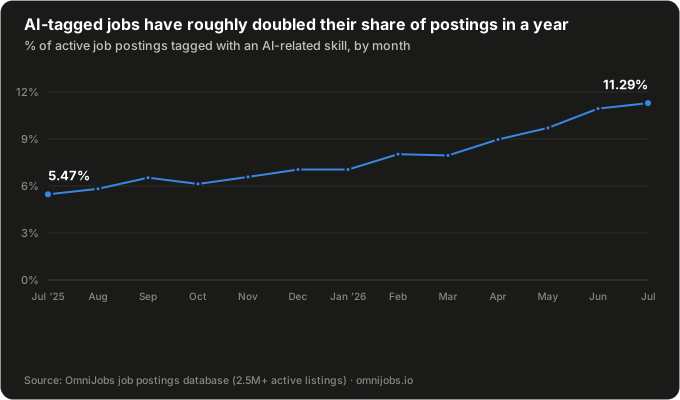
AI-tagged postings went from 5.5% of all active listings in our database in July 2025 to 11.3% in July 2026 — roughly double, in twelve months. That's directionally consistent with Stanford HAI's cross-sectional 2.5% figure (a different methodology and scope — theirs is U.S.-specific and keyword-in-posting-text, ours is global and tag-based — so the absolute numbers aren't meant to line up, but both point the same direction: AI requirements are becoming standard rather than a specialty callout).
🤖 Finding 2: Claude and Agentic AI Are Growing Faster Than "AI" as a Whole
This is the number that's actually ours — nobody else is positioned to measure it the way a live job-posting database can.
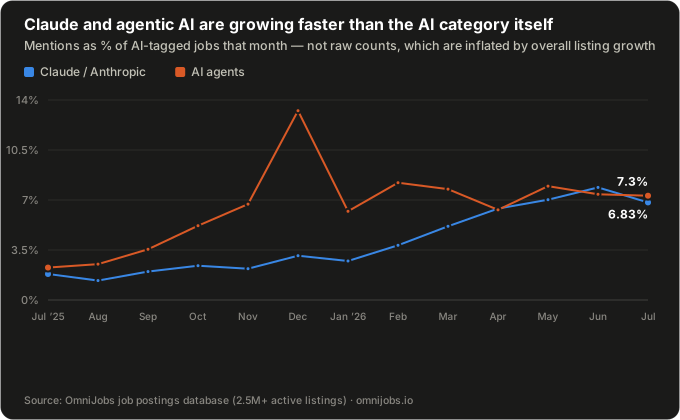
We normalized this one further than Finding 1 — not just as a share of all postings, but as a share of AI-tagged postings specifically, to isolate subfield growth from category growth. By that measure, mentions of Claude or Anthropic grew from 1.82% to 6.83% of AI-tagged jobs over the same 13 months — roughly 3.7x its own starting share, well ahead of the category's ~2x growth. "AI agents" terminology (agentic AI, AI agents, CrewAI, Agentforce) shows a similar pattern, ending at 7.3%.
One honest caveat: AI agents mentions spiked to 13.25% in December before settling back into the 7–8% range — worth flagging as a single-month outlier (a smaller base month, possibly a handful of large batch postings) rather than a durable level. This is exactly why we're running this as a monthly-updated series instead of a one-time claim — a spike like that either repeats or it doesn't, and we'll know next month.
There's a real tension worth naming here: LinkedIn's Economic Graph lists "prompting" among the fastest-growing skills on their platform in 2026 — but in our own title data, "Prompt Engineer" as a standalone job title is nearly extinct (102 postings in six months, against 4,911 for "AI Engineer"). Read together, the likely explanation is that prompting became an expected skill folded into other roles rather than a job title of its own — a distinction a skills survey and a job-title database will naturally see differently, and a good example of why cross-checking sources beats trusting any single one.
💼 Finding 3: Data Scientist and AI Engineer Dominate AI-Adjacent Hiring
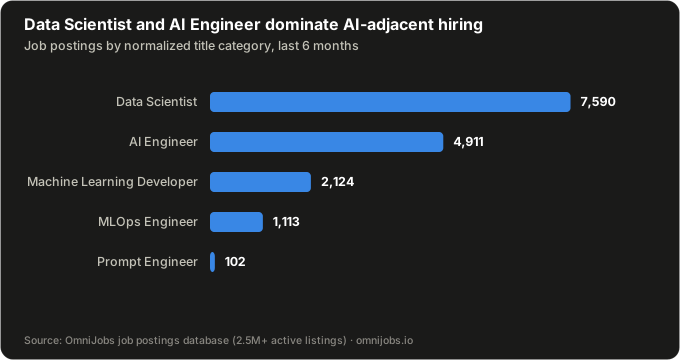
Among our five AI-adjacent title categories, Data Scientist and AI Engineer together account for the large majority of postings in the last six months. MLOps Engineer, a role that barely existed as a distinct title a few years ago, already outnumbers Prompt Engineer by more than 10 to 1 — a small but telling signal about where the market thinks the durable AI-adjacent jobs actually are: building and operating systems, not writing prompts.
💰 Finding 4: AI Roles Don't Pay More on the Floor — They Pay More at the Ceiling
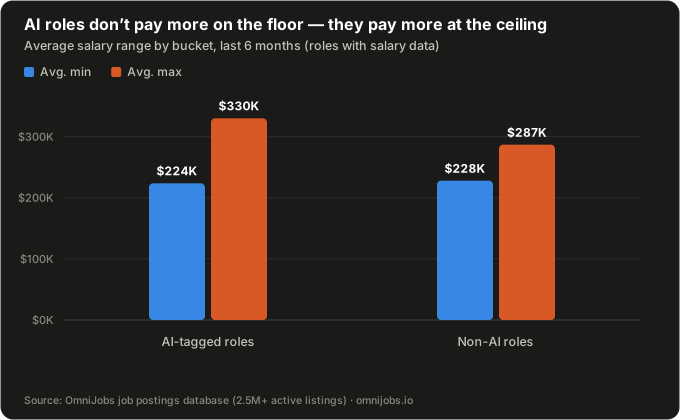
This is the finding we'd have gotten wrong if we'd only checked the average. The average salary floor for AI-tagged roles ($224K) is essentially identical to non-AI roles ($228K) — actually slightly lower. But the average ceiling is 15% higher ($330K vs. $287K). The honest read isn't "AI pays more" — it's that AI roles have a meaningfully wider salary band, with more room at the top and no real premium at the bottom. If you're negotiating an AI-adjacent offer, the data says your leverage is in the ceiling, not the floor. For salary benchmarks across the whole market (not just AI roles), including a full seniority-to-pay ladder, see our Salary Benchmarks by Job Title 2026 report.
🌍 Finding 5: AI Roles Are More Than 2x as Likely to Be Remote
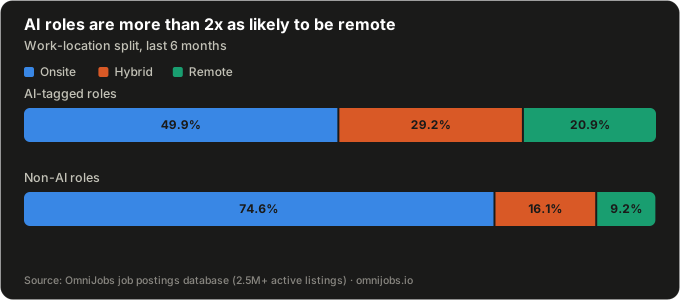
AI-tagged roles are remote 20.9% of the time, against 9.2% for the rest of the market — better than double. Hybrid follows the same pattern (29.2% vs. 16.1%), and onsite drops from 74.6% of non-AI roles to 49.9% of AI-tagged ones. If you're running a global job search and specifically targeting AI-adjacent work, remote and hybrid options are genuinely more available to you than the market average — not a marginal edge, a structural one.
🧭 What This Means If You're Job Searching Right Now
- Don't wait for "Prompt Engineer" to become a real career track. The market has already answered that question — the durable titles are Data Scientist, AI Engineer, and increasingly MLOps Engineer. Prompting is a skill to have, not a title to chase.
- Negotiate on the ceiling, not the floor. If a recruiter opens with a number near the market floor, the data says there's more room above it in AI-adjacent roles than in a typical role.
- If remote matters to you, AI-adjacent roles are your best odds in this market — a genuinely different distribution from the rest of the job market, not a marginal tilt.
- Treat single-month spikes with suspicion, including ours. The December "AI agents" spike above is a reminder that one strong month isn't a trend — check back for the update.
🚀 Try OmniJobs
Every stat above came from the same database that powers OmniJobs' daily AI-matched job scan — 2.5 million+ listings, refreshed hourly, scored against your actual resume rather than keyword overlap. If you're navigating an AI-adjacent job search or a transition into one, that's exactly what it's built for.
👉 Visit OmniJobs and get matched against the same data behind this report.
🗓️ Update Log
- August 2026 — Initial publication. Data covers July 2025–July 2026 (trends) and the trailing 6 months (titles, salary, location).